
Behind sinks and toilets
Slow plumbing drips are the most common indoor cause. The cabinet floor and the drywall behind it stay wet for months before anyone notices.
Black mold removal
Dark mold on drywall, ceilings, framing or cabinets removed under containment, with the damp that fed it traced and dealt with so it doesn't come back.
Phone answered 24 hours a day. Talk to a remediation specialist now.
"Black mold" is an everyday name for any mold that looks dark green, gray or black. It is often used to mean one particular species, but you can't tell a species by looking at it, and plenty of common household molds are dark. Color doesn't decide how the growth should be handled.
What matters is how much there is, what it is growing on and why it is there. Dark growth almost always means a surface has stayed wet for a while: a leak, condensation, or a room that never dries. Our article what is black mold covers the background. This page is about getting it out.
Dark mold follows water. These are the places it turns up most.
Slow plumbing drips are the most common indoor cause. The cabinet floor and the drywall behind it stay wet for months before anyone notices.
Winter storms test flat and low-slope roofs. Ceilings below a failed seam or flashing often show dark spotting after the rainy season.
Stucco can hold moisture against the wall sheathing, and window leaks run down inside the cavity. Closets on outside walls are a frequent spot.
Stacked plumbing in condos and apartment buildings means a leak upstairs can end up as mold in your unit.
Removal without fixing the source just resets the clock. We confirm where the moisture comes from, and it is repaired before or during the work.
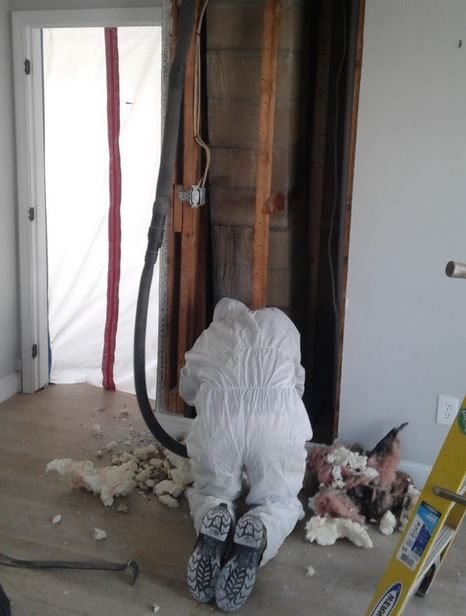
Plastic sheeting and a zipper door seal the work area, and a negative air machine exhausts to the outside so spores don't drift into the rest of the home.
Affected drywall, insulation, carpet pad and baseboards are cut out past the visible growth, bagged inside containment and removed.
Framing and other solid materials are HEPA vacuumed and cleaned. Stained wood may be sanded where growth has gone into the surface.
Materials are dried and moisture readings confirmed. Air scrubbers run throughout, and a final inspection or clearance testing comes before rebuilding.
Seeing or smelling mold? Call and describe what you're dealing with. We'll tell you what it likely means and arrange an inspection. Phone answered 24/7.
The material the mold is growing on decides the method.
| Material | Usual approach |
|---|---|
| Drywall and plaster | Remove and replace the affected section, cut back past the visible edge |
| Fiberglass or cellulose insulation | Remove and bag; it can't be cleaned |
| Wood framing and subfloor | HEPA vacuum, clean, and sand if growth has gone into the surface; replace if the wood is decayed |
| Tile, glass, metal | Clean the surface; check what is behind it |
| Carpet and pad | Usually removed when growth or long-term wetting is involved |
| Cabinets | Solid wood can often be cleaned; particleboard that has swelled is usually replaced |
Bleach is not on the list. It can lighten a stain without dealing with growth inside porous materials, and it adds water. Our post on why bleach doesn't fix mold explains the problem.
Disturbing mold is what releases the most spores. Cutting drywall, pulling insulation and bagging debris all put dust in the air, so the setup around the work matters as much as the removal itself.
Inside the containment, the air is kept at lower pressure than the rest of the home, so any leak in the plastic draws air in rather than pushing dust out. HEPA air scrubbers filter the air during the work. Debris is double-bagged before it leaves the work area, and the path to the door is protected. Heating and cooling vents in the work area are sealed so the system doesn't spread dust to other rooms.
For a small closet or a single wall, this can be a compact setup. For a larger area, or a home where someone has asthma or allergies, it covers more ground. We explain the layout before any work starts.
For a fuller picture, see what drives mold remediation cost.
If the mold appeared after a burst pipe or roof leak, mold after water damage covers drying and removal together. For growth concentrated around a shower or tub, see bathroom mold removal. Not sure how far it goes? Start with a mold inspection.
We remove black mold across Los Angeles and nearby cities, including Glendale and Burbank. See every area we serve, or call (424) 479-7915 any time.
Color alone doesn't tell you. Many different molds look dark green or black, and the name is not a species. The EPA and CDC advise treating any indoor growth the same way: remove it and fix the moisture. If someone in the home has health concerns, talk to a doctor.
For a small area on a hard surface, roughly 10 square feet or less by the EPA's general guidance, many homeowners can clean it carefully with detergent and water while wearing gloves and eye protection and an N95 respirator. Larger areas, growth inside walls, or anyone with health concerns in the home are reasons to call a professional.
Drywall paper and gypsum are porous. Growth reaches into the material, so surface cleaning leaves roots behind and the stain usually returns once the area gets damp again. Affected drywall is cut out past the visible edge and replaced.
No. Paint, including mold-resistant primers, covers the stain but not the growth or the moisture behind it. The mold keeps growing and eventually shows through or lifts the paint.
Talk to a specialist
Tell us what you're seeing, smelling or worried about. We'll ask a few questions, explain what it likely means, and arrange an inspection and a written scope.
(424) 479-7915Phone answered 24 hours a day, 7 days a week
Call now, 24/7