
No outdoor baseline
Without it, an indoor spore count has nothing to be compared with and can look alarming for no reason.
Mold testing
Air and surface sampling analyzed by a laboratory, used when you need documented results, and clearance testing to confirm a remediated area is ready to be rebuilt.
Phone answered 24 hours a day. Talk to a remediation specialist now.
Mold testing means collecting samples, either from the air or from a surface, and sending them to a laboratory. The lab identifies the types of mold present and, for air samples, how many spores were captured. That gives you documented data, which a visual check alone cannot.
Testing does not find the leak, and it does not tell you how far growth has spread inside a wall. That is the job of a mold inspection. The two often go together, but they answer different questions, and paying for sampling when you really need an investigation is a common mistake. Our article on mold inspection vs mold testing lays out the difference in more detail.
Each method answers a different question. We pick based on what you need to know.
| Method | How it works | What it tells you |
|---|---|---|
| Air sample (spore trap) | A pump draws a measured volume of air through a cassette that captures airborne particles | Spore types and counts in the air, compared with an outdoor baseline |
| Wall cavity air sample | Air is drawn from inside a wall through a small hole | Whether a closed cavity likely holds growth that room air doesn't show |
| Tape lift | Clear tape is pressed on a suspect surface and sent to the lab | Whether a stain or residue is actually mold growth, and what type |
| Swab sample | A sterile swab is wiped over a defined area | Growth on rough or uneven surfaces where tape won't adhere |
| Bulk sample | A small piece of material, such as drywall or carpet, is removed | Growth within a material rather than only on its surface |
Seeing or smelling mold? Call and describe what you're dealing with. We'll tell you what it likely means and arrange an inspection. Phone answered 24/7.
We confirm what you need the results to show, since that decides where and how many samples to take.
Doors and windows should be kept at their usual positions before sampling. Running an air purifier or cleaning heavily beforehand can skew results.
An outdoor air sample is taken first, away from vents and landscaping debris.
Air samples in the rooms of concern and a comparison room, plus surface samples of any suspect material.
Samples go to an analytical laboratory with a chain-of-custody record so the results are traceable.
We go through the report with you, explain what it shows and what it can't, and recommend next steps.
After remediation
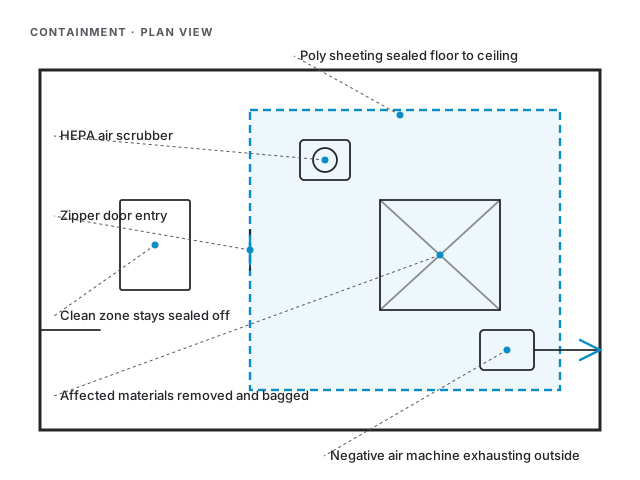
Clearance testing is the final check on a mold remediation project. It happens after contaminated materials are removed and surfaces are HEPA vacuumed and cleaned, while containment is still up and before new drywall goes in.
The area is inspected first. There should be no visible growth or dust and the materials left in place should be dry. Air samples inside containment are then compared with the outdoor baseline. If the results come back elevated, the area is cleaned again and retested before anything is closed up.
Some owners prefer clearance sampling done by a separate, independent party, particularly for rentals or sales. That is a reasonable choice, and we are happy to coordinate with whoever you bring in.
Without it, an indoor spore count has nothing to be compared with and can look alarming for no reason.
Paying for a lab report on visible black mold that has to come out anyway rarely changes the plan.
Near the ocean in places like Santa Monica, the marine layer keeps humidity higher. Conditions change day to day, so indoor samples are always read against a same-day outdoor sample.
We take samples in homes and buildings throughout Los Angeles, including Beverly Hills and Glendale. See all of our service areas, or call (424) 479-7915 any time of day to talk through whether testing makes sense for you.
Usually not to decide whether to remove it. Visible growth should be cleaned up and its moisture source fixed whatever the species. Testing is more useful for hidden problems, documentation, or confirming that remediation worked. The EPA makes the same general point about visible mold.
Mold spores are always present in outdoor air. The outdoor sample is the baseline: indoor results are judged by how they compare with it in both the types of mold and the amounts found, not against zero.
It is the check done after remediation and before containment comes down or walls are closed. The area is inspected visually, then air and sometimes surface samples are collected to confirm spore levels have returned to a normal range compared with the baseline. Our clearance testing guide explains it step by step.
Settle-plate kits that sit open on a counter will grow something almost anywhere, because spores are everywhere. They do not measure concentration or compare against outdoor air, so a positive result on its own tells you very little.
Talk to a specialist
Tell us what you're seeing, smelling or worried about. We'll ask a few questions, explain what it likely means, and arrange an inspection and a written scope.
(424) 479-7915Phone answered 24 hours a day, 7 days a week
Call now, 24/7