
A clear scope before work starts
Which units or rooms, what gets removed, and what the tenants will see and hear.
Commercial mold
Mold in a building people work, shop or live in brings extra problems: tenants, customers, shared walls, and owners who need a clear record of what was done. We plan the work around all of it.
Phone answered 24 hours a day. Talk to a remediation specialist now.
The basic remediation process is the same in a restaurant as in a house: find the moisture, contain the area, remove what's damaged, clean, dry and verify. What changes in a commercial building is everything around that process.
There are people who need to keep working or living there, owners and managers who have to approve the work, neighbors on the other side of shared walls, and often a paper trail that has to satisfy someone else later.
| Building type | Common mold sources | What planning has to cover |
|---|---|---|
| Offices | Roof leaks, HVAC condensation, restroom plumbing | Staff access, IT and furniture protection, shared air systems |
| Retail | Storefront and window leaks, back-of-house plumbing | Customer areas, inventory, visible containment |
| Restaurants | Dish areas, walk-in coolers, floor drains, hood and roof leaks | Food areas kept separate, timing around service |
| Multi-unit residential | Stacked plumbing, shared walls, balcony and roof leaks | Tenant notice and access, several units affected by one source |
| HOA common areas | Garages, laundry rooms, trash rooms, hallway ceilings | Board approval, resident communication, common vs unit responsibility |
We look at the affected area, the building's layout and air handling, and talk about who uses the space and when.
Moisture readings and, where needed, opening up walls or ceilings to see how far growth goes. Independent mold testing can be added if the owner wants lab data.
Areas, containment, removal, access routes, and a proposed schedule that the owner, tenants and other trades can plan around.
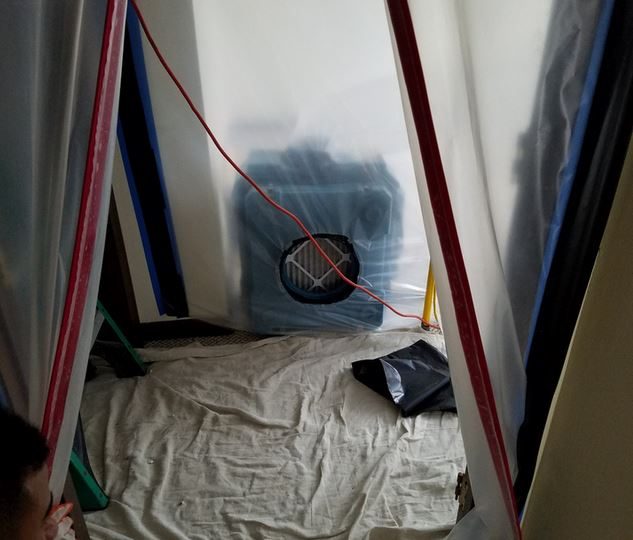
Poly walls, sealed returns and negative air exhausted outside, so the work area stays separated from occupied space.
Removal, HEPA vacuuming, cleaning and drying, following the same sequence as our mold remediation process.
Visual and moisture checks, optional clearance testing, and the documentation package for the owner's records.
Seeing or smelling mold? Call and describe what you're dealing with. We'll tell you what it likely means and arrange an inspection. Phone answered 24/7.
For owners and managers
Which units or rooms, what gets removed, and what the tenants will see and hear.
Plumbers, roofers and drywall crews need to come in at the right point, not before the area is clear.
Photos, moisture readings and a written summary for owners, boards and any later questions.
Plain explanations of what's happening, without speculation about health or blame.
Los Angeles buildings
Los Angeles has a huge stock of apartments and condos with shared walls and stacked plumbing. One failed line on an upper floor can send water down through several units before anyone reports it.
Flat roofs are common on commercial and mid-century buildings, and winter storms find their weak spots. Buildings near the coast deal with marine-layer humidity in storage rooms and basements that rarely get fresh air.
Most start small and get expensive because nobody owned the problem early.
A tenant keeps reporting a musty smell or spots on a bathroom ceiling. Surface cleaning hasn't stopped it, which usually means a leak or ventilation issue behind the finish. Our bathroom mold removal page covers the common causes.
Flat roofs over offices and shops let water into ceiling tiles and insulation. By the time stains show, growth above the grid is often wider than the stain.
Restaurant dish areas, storage rooms and spaces behind coolers stay damp and out of sight until an inspection or a smell draws attention to them.
A leak in one unit shows up as mold in the next. Sorting out the source comes before sorting out who pays. See mold after water damage.
We work with owners, managers and HOAs across Los Angeles, including Beverly Hills, Glendale and Long Beach. See all service areas. Our phone is answered 24 hours a day, so a manager dealing with a leak at night can reach us.
Often it can, at least in part. Containment and negative air keep the work area separated from occupied space. Whether it's practical depends on where the mold is, how the space is laid out and what the business does. We'll talk through the options once we've seen the building.
Scheduling outside normal business hours can be discussed when you call. It depends on the scope, building access rules and the timing of any other trades involved.
You get a written scope describing the affected areas, the moisture source, the containment used, what was removed and cleaned, and how the area was verified before containment came down. Photos document conditions before and after. If you want independent clearance testing, we coordinate around it.
Either can call to talk it through, but work in a rental or common area needs the owner or manager's approval. For tenants, our guide to mold in apartments and rentals explains practical first steps.
Mold in air handlers and ducts is assessed as its own scope because it can affect air across a whole floor. See HVAC mold removal for how that part is handled.
Talk to a specialist
Tell us what you're seeing, smelling or worried about. We'll ask a few questions, explain what it likely means, and arrange an inspection and a written scope.
(424) 479-7915Phone answered 24 hours a day, 7 days a week
Call now, 24/7