
Under the sink
Slow drips at the supply lines, shutoff valves or drain trap soak the cabinet floor. Look for swollen particleboard and a musty smell when you open the doors.
Prevention
Bathroom mold grows where water sits and air doesn't move. Get the steam out, keep the seals tight and dry the room after every shower, and most of it never gets a start.
To prevent bathroom mold, remove moisture faster than it builds up. That means running a working exhaust fan during every shower and for a while after, keeping caulk and grout sealed, wiping or squeegeeing wet surfaces, and fixing any drip or leak as soon as you notice it. Mold needs moisture that lasts. A bathroom that dries out within an hour or two of a shower gives it very little to work with.
If you already have spots that come back no matter how often you scrub, prevention alone won't fix that. Recurring growth usually means moisture is getting somewhere you can't see, such as behind the tile, under the vanity or inside the wall.
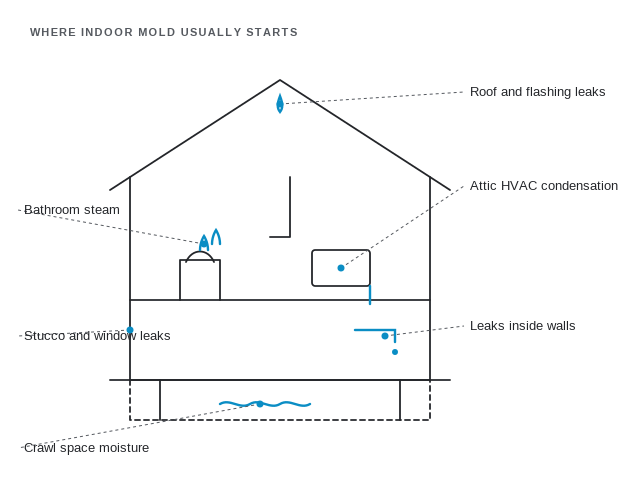
A hot shower puts a lot of water vapor into a small room. If that vapor has nowhere to go, it condenses on the coolest surfaces: the mirror, the window, the ceiling above the shower and the outside wall. Those are exactly the places mold shows up first.
Many fans are noisy but weak, or they vent into the attic instead of outside. Hold a single square of toilet paper up to the grille with the fan running. If it doesn't pull the tissue flat against the cover, the fan isn't doing much. Common causes are a clogged grille, a crushed or disconnected duct, a stuck damper or a motor near the end of its life.
Turning the fan off when you step out of the shower leaves most of the moisture behind. Let it run for roughly 20 to 30 minutes afterward. A timer switch or a humidity-sensing switch takes the guesswork out of it, and both are simple swaps for an electrician.
A fan that dumps moist air into the attic just moves the problem upstairs. In Los Angeles homes with attic ductwork, this is a common reason for dark staining on the roof sheathing above a bathroom. If you're not sure where your fan ends, look in the attic for the duct and follow it to a roof or wall cap.
Older bungalows and some apartments only have a window. Open it during and after the shower, keep the door open once you're done, and consider a small portable fan pointed out the window to push humid air out.
Tile and grout are not waterproof. They shed most water, but cracked grout and failing caulk let it into the wall and floor behind. Once it's there, it dries slowly, and that is where hidden mold starts.
None of these take long. Together they make a noticeable difference in how fast a bathroom dries.
On bleach: it can lighten stains on hard, non-porous tile, but it doesn't solve a moisture problem and doesn't reach growth inside grout, drywall or wood. We explain why in why bleach doesn't fix a mold problem.
Sometimes the bathroom is well ventilated and still grows mold. When that happens, look for water coming from somewhere other than the air.
Slow drips at the supply lines, shutoff valves or drain trap soak the cabinet floor. Look for swollen particleboard and a musty smell when you open the doors.
A failing wax ring leaks a little with every flush. Signs include a rocking toilet, stained grout at the base or a soft floor.
A leaking valve or failed waterproofing may show up as loose tiles, bubbling paint on the other side of the wall or staining on the ceiling below.
In apartments and condos with stacked bathrooms, water can come from the unit above. Ceiling stains in a bathroom are worth reporting quickly.
If you suspect one of these, a mold inspection focuses on finding the moisture source and how far growth has spread, using moisture meters and a careful look at the areas around the wet spot.
The EPA's general guidance is that small areas of mold, roughly 10 square feet or less, are often manageable by a homeowner, while larger or hidden growth is better handled by professionals. The same guidance stresses that the moisture has to be fixed or the mold will return.
In a bathroom, the signs that it's time for help are growth that returns within weeks of cleaning, spots on drywall or the ceiling that keep spreading, soft or crumbling wall material around the tub, and a musty smell that doesn't clear with ventilation. Professional bathroom mold removal sets up containment, removes damaged materials rather than painting over them, and dries and cleans the area so it can be rebuilt properly.
If anyone in the home has allergies or asthma and notices symptoms around the bathroom, the CDC notes that mold can trigger those in some people. Talk to a doctor about health concerns, and deal with the moisture either way.
Seeing or smelling mold? Call and describe what you're dealing with. We'll tell you what it likely means and arrange an inspection. Phone answered 24/7.
Dealing with mold right now?
If this guide sounds like what's happening in your home or building, call us and we'll talk it through. You can also read how we handle bathroom mold removal.
Phone answered 24 hours a day, 7 days a week