
Upstairs clues
A musty smell in rooms with wood floors, especially after the house has been closed up. Floors that feel soft, bouncy or cupped. Hardwood boards that swell or gap seasonally more than they used to.
Crawl spaces
Plenty of older Los Angeles homes sit on raised foundations with a crawl space underneath. That space is easy to forget about until a musty smell or a soft floor brings it to your attention.
Crawl space moisture in a raised-foundation home usually comes from one of four places: plumbing leaks from the supply and drain lines that run under the floor, rainwater that drains toward the house instead of away from it, damp soil releasing moisture into the air, and blocked foundation vents that stop that air from moving. In most homes it's a combination, and the fix depends on which sources are active.
The wood framing under your floor, the joists, subfloor and sill plates, is where mold takes hold once the space stays damp for long enough.
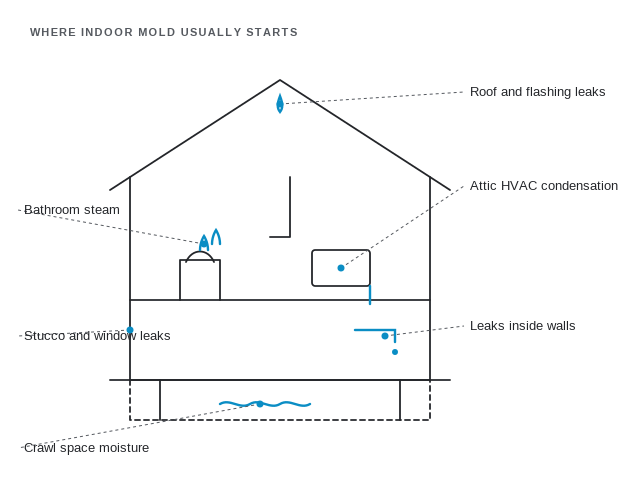
You don't have to go under the house to notice some of these. Many show up in the rooms above.
A musty smell in rooms with wood floors, especially after the house has been closed up. Floors that feel soft, bouncy or cupped. Hardwood boards that swell or gap seasonally more than they used to.
Standing water or mud, wet or stained soil, dark spotting or fuzzy growth on joists, sagging insulation between joists, rusted pipes or fittings, and a strong damp odor.
Downspouts that empty right at the foundation, soil or planters sloping toward the house, vents buried by mulch or blocked by stored items, and efflorescence (white mineral deposits) on the foundation.
Supply lines, drain lines and water heater connections run through the crawl space. A slow drip from a fitting or a cracked cast iron drain can keep one area wet for months without anyone noticing. Plumbing leaks and slow drips are the most common indoor cause of mold in LA homes generally, and a crawl space hides them well.
Los Angeles is dry most of the year, which makes it easy to overlook drainage. Then the winter rainy season brings a few heavy storms, and water that runs toward the house ends up under it. Hillside homes are especially prone, since water moving downhill meets the uphill side of the foundation. Short downspouts, flat or reverse-sloped soil, and clogged area drains all contribute.
Bare soil gives off moisture even when it looks dry on top. In a closed-up crawl space with poor airflow, that moisture raises humidity against the underside of the floor.
Raised foundations here are usually vented, with openings in the foundation walls that let air move through. Vents covered by plants, soil, stored items or later additions let humidity build up.
Ducts under the floor can sweat in summer or leak, and a dryer vent that ends in the crawl space instead of outside dumps warm, wet air straight into it.
| Fix | Addresses | Notes |
|---|---|---|
| Plumbing repair | Leaks under the floor | Always first if there's an active leak. Nothing else holds while pipes drip. |
| Gutter and downspout extensions | Roof water at the foundation | Simple and often overlooked. Discharge well away from the house. |
| Regrading or drains | Surface water flowing toward the house | Soil should slope away. Hillside lots may need area or French drains. |
| Clearing and adding vents | Stagnant, humid air | Works well in many LA homes because outdoor air is dry most of the year. |
| Vapor barrier on the soil | Ground moisture | Plastic sheeting over bare dirt limits evaporation into the space. |
| Encapsulation with dehumidification | Persistent humidity | A larger project; vents are sealed and the space is conditioned. Worth discussing with a contractor for your specific house. |
Use a bright flashlight from the access hatch. If you go in, wear a respirator, gloves and coveralls, and watch for nails, wiring and pests. If it's tight or wet, leave it to a professional.
Check the water meter with all fixtures off. If it moves, water is going somewhere.
Walk the house after a rain. Note where water pools and where downspouts empty.
A mold inspection measures moisture in the framing, maps visible growth and identifies which sources are active.
Mold under the floor doesn't always stay there. Air moves up from a crawl space into the house through gaps around pipes and floor registers. If you're also noticing musty rooms or spots on lower walls, signs of hidden mold covers what else to check.
Crawl space growth often covers large areas of joists and subfloor, well beyond the roughly 10 square feet the EPA describes as manageable for homeowners, and the space itself is awkward and dirty to work in. Crawl space mold removal typically involves removing wet or moldy insulation, cleaning or treating the framing, HEPA vacuuming the space and making sure the moisture source has been corrected so the work lasts.
Seeing or smelling mold? Call and describe what you're dealing with. We'll tell you what it likely means and arrange an inspection. Phone answered 24/7.
Dealing with mold right now?
If this guide sounds like what's happening in your home or building, call us and we'll talk it through. You can also read how we handle crawl space mold.
Phone answered 24 hours a day, 7 days a week