
After a leak
Preventing Mold After a Leak: The First 48 Hours
The time right after a leak decides whether you end up with a drying job or a mold job. Here is what to do, in order, and what to leave alone.
The short version
To prevent mold after a leak, stop the water, then get everything that got wet dry as quickly as you can. The EPA and CDC commonly cite 24 to 48 hours as the window for drying wet materials before mold is likely to start growing. Move out belongings, pull up soaked rugs and pads, open the area up to air, run fans and a dehumidifier, and remove materials like wet drywall or insulation that won't dry in place. If water got into walls, ceilings or floors, or the area is large, get help early rather than waiting to see what happens.
That window is general guidance, not a precise countdown. Some materials dry faster, some slower, and a small drip that ran for weeks before anyone noticed is already past it.
The first few hours
Stop the water
Shut off the fixture valve, or the main if you can't find the source. Know where your main shutoff is before you need it. In apartments, the building may have shutoffs for each unit or for a whole plumbing stack; call the manager right away.
Make it safe
If water is near outlets, fixtures or the electrical panel, turn off power to that area at the breaker. Stay out of rooms with sagging ceilings.
Document it
Photos and video of the source and the wet areas, before you move things, help with insurance claims and with any repairs later.
Remove standing water
Mop, towel or use a wet vacuum. The less water that soaks into materials, the faster they dry.
Get belongings out
Move furniture, boxes, rugs and electronics out of the wet area. Put foil or blocks under furniture legs that can't be moved.
Drying: the next 48 hours
Drying is where mold is prevented or not. The goal is to get moisture out of the materials, not just off the surface.
Move air and pull moisture
- Run fans aimed across wet surfaces, not just at the room in general.
- Run a dehumidifier in the closed-off area and empty it often.
- Open windows if the outdoor air is dry. On foggy or rainy days, keep them closed and rely on the dehumidifier.
- Keep the heat moderate; warm air holds and carries off more moisture.
Open things up
- Pull wet carpet back and remove soaked padding, which rarely dries well in place.
- Open cabinet doors and remove toe kicks under sinks so air reaches the cabinet floor.
- Take baseboards off walls that got wet, which also shows you how high the water wicked.
Decide what stays and what goes
| Material | Usually |
|---|---|
| Tile, sealed concrete, metal, glass | Clean and dry |
| Solid wood framing and furniture | Dry thoroughly; may be salvageable |
| Carpet | Sometimes salvageable if dried quickly and the water was clean |
| Carpet pad | Usually replaced |
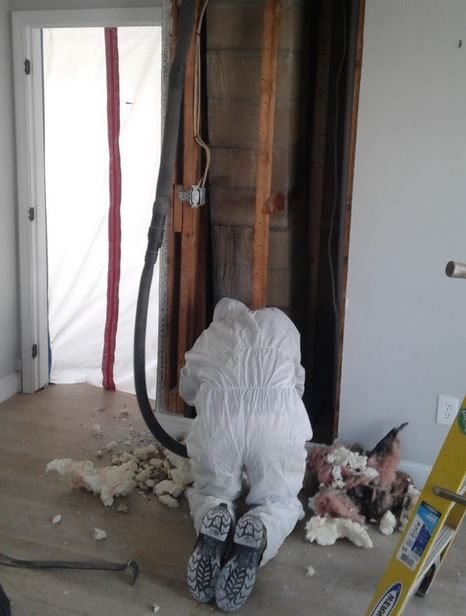
| Drywall | Often cut out above the wet line if soaked |
| Insulation | Usually removed if wet |
| Particleboard cabinets and furniture | Often swell and don't recover |
What not to do
- Don't wait and see. Surfaces that feel dry can still hold moisture inside. Drywall and wood dry from the outside in.
- Don't close it up. Painting, patching or putting baseboards back on before materials are dry traps moisture where you can't see it.
- Don't rely on bleach. It doesn't dry anything, and it doesn't prevent growth inside porous materials.
- Don't use heaters alone. Heat without air movement or dehumidification can raise humidity and spread moisture to other rooms.
- Don't ignore the ceiling below. In two-story homes and apartments, water travels down. Check the rooms under the leak.
- Don't handle sewage water yourself. Water from a toilet overflow or sewer backup needs different handling. Keep people and pets away from it.
Common leaks in Los Angeles homes
Plumbing leaks and slow drips are the most common indoor cause, from supply lines, water heaters, washing machine hoses and dishwasher connections. Roof and window leaks show up during the winter rainy season, sometimes after months of dry weather have hidden a failing seal. AC condensate lines in attics can overflow in summer. In apartments, a leak in the unit above is always a possibility.
Roof leaks carry their own risks because the water often travels before it shows. For what to check after a storm, see mold after a roof leak.
When to call for help
Some leaks are a mop and a fan. Others need more. It's worth getting a professional involved when:
- Water got inside walls, ceilings or under flooring
- The wet area is large, or more than one room is affected
- The leak ran for days or weeks before it was found
- You already smell mustiness or see spots
- Materials are still reading wet after two days of drying
If more than 48 hours have passed or growth is already visible, the job is no longer just drying. Our page on mold after water damage explains how affected materials are removed and the area is cleaned under containment. If you're not sure how far the water went, a mold inspection uses moisture readings to trace it inside walls and floors.
The EPA's general guidance is that areas of roughly 10 square feet or less are often manageable by homeowners, while larger or hidden growth is better handled by professionals. Either way, the moisture source has to be fixed for any cleanup to last.
Seeing or smelling mold? Call and describe what you're dealing with. We'll tell you what it likely means and arrange an inspection. Phone answered 24/7.
Dealing with mold right now?
Talk to a mold remediation specialist
If this guide sounds like what's happening in your home or building, call us and we'll talk it through. You can also read how we handle mold after water damage.
Phone answered 24 hours a day, 7 days a week